Back
πŸ“–

CHORD THEORY

πŸ“–

Chord Theory & Tips

Master the building blocks of music. From basic major chords to professional two-hand techniques.

πŸ’‘ What is a Chord?

At its simplest, a chord is a group of notes played together at the same time. While you can play any combination of notes, the most common chords in pop music are Triadsβ€”which consist of three specific notes.

✨ The Magic Formula

Most chords are built by taking a Root note, skipping a note, taking the next, skipping another, and taking the third. This is called playing in thirds!
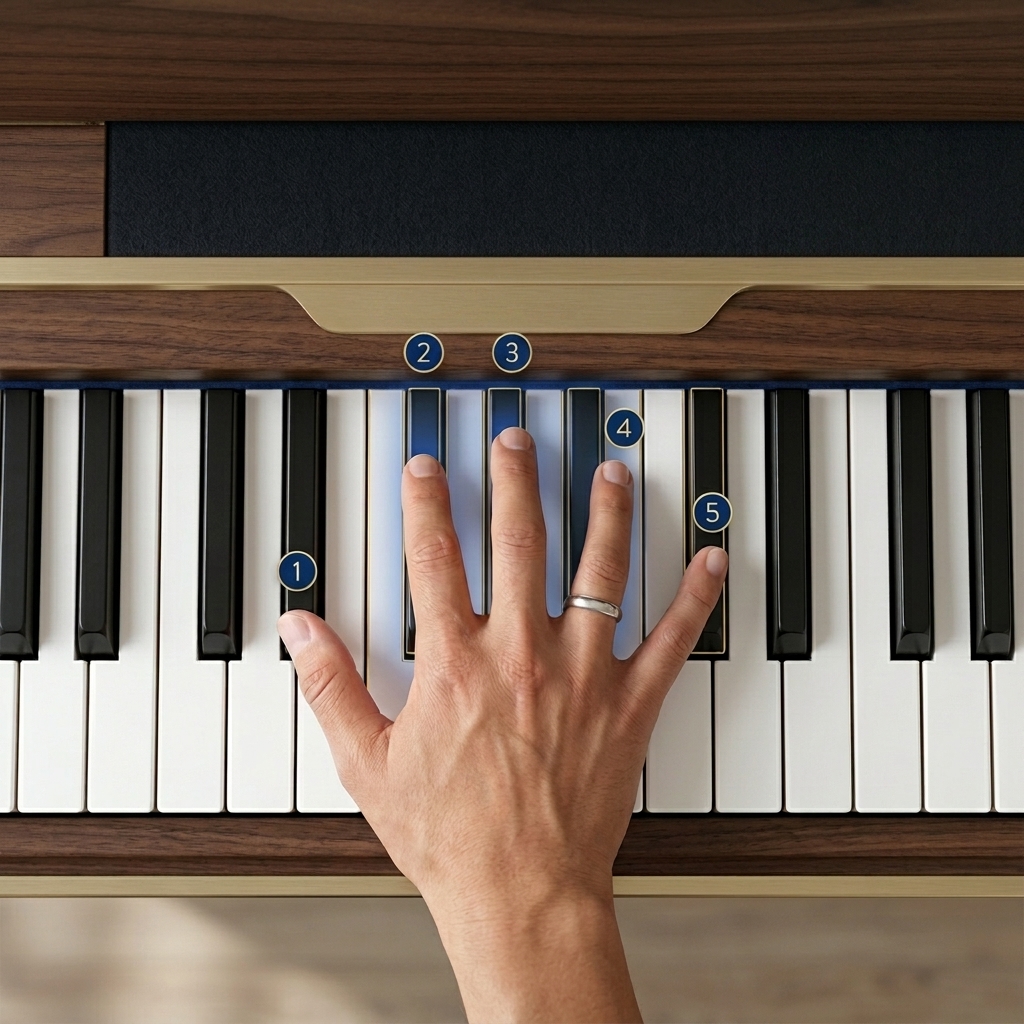
Finger numbering for the right hand

Finger numbering for the right hand

🎹 The "Shape" Secret

Did you know? On the piano, many chords share the exact same physical "shape." If you learn the hand position for one, you've learned them all for that group!

The "All White" Shape
C β€’ Dm β€’ Em β€’ F β€’ G β€’ Am

All three notes are played on White Keys. Hand sits flat.

1 3 5
Example: C Major
The "Valley" Shape
C# β€’ D# β€’ G#

Black - White - Black pattern. Your middle finger dips down into the valley.

1 3 5
Example: C# Major
The "Mountain" Shape
A β€’ D β€’ E β€’ Cm β€’ Fm β€’ Gm

White - Black - White pattern. Your middle finger reaches up to the mountain peak.
1 3 5
Example: D Major
Special "Outliers"
B: W-B-B β€’ Bm: W-W-B β€’ A#: B-W-W
1 3 5
Example: B Major

🎹 Building Major & Minor Chords

The difference between a "happy" Major chord and a "sad" Minor chord is just one half-step on the middle note.

🏷️ Chord Names:

In the music world, "C Major" is usually just called "C". If you see a chord name on its own (like G, F, or C), it's a Major chord. When it has that little "m" behind its name, it's called a minor Chord! Am would mean an A Minor chord.

C C - E - G
Cm C - Eb - G
D D - F# - A
Dm D - F - A
E E - G# - B
Em E - G - B
F F - A - C
Fm F - Ab - C
G G - B - D
Gm G - Bb - D
A A - C# - E
Am A - C - E
B B - D# - F#
Bm B - D - F#

Sharps (#) and Flats (b)

Don't be afraid of the black keys! A C# (C Sharp) is just the key directly to the right of C. An Eb (E Flat) is the key directly to the left of E. They are the same black keys, just named based on which white key you're referencing.

C MAJOR
C# MAJOR
C E G
C# F G#

πŸ’‘ The Half-Step Principle: Notice how every single key shifts exactly one position to the right when moving from C Major to C# Major.

Major Chords

Physical Finger Patterns Cheat Sheet
White - White - White
C Major
F Major
G Major
White - Black - White
D Major
E Major
A Major
Black - White - Black
C# Major
Eb Major
Ab Major
Other
F# Major
B Major
Bb Major

🎹 Minor Chords

To turn any Major chord into a Minor chord, simply move the middle note (it's called the "third") exactly one key to the left. This "lowering of the third" instantly transforms a bright, happy sound into a moody, sad tone.

πŸ’‘ Pro Tip: Just One Step

Even if the middle note is a black key (like in D Major), you still just move it one step left (to the white key). The pattern is always the same!

πŸ”„ Chord Inversions

You don't always have to play the Root note at the bottom. Shuffling the notes makes transitions smoother and sounds more professional.

Root Position (C)

Notes: C - E - G

The standard "home" shape.

1st Inversion

Notes: E - G - C

Move the C to the top. Great for connecting to F chords!

2nd Inversion

Notes: G - C - E

Move the E to the top. Sounds very powerful and stable.

πŸ™Œ Playing with Two Hands

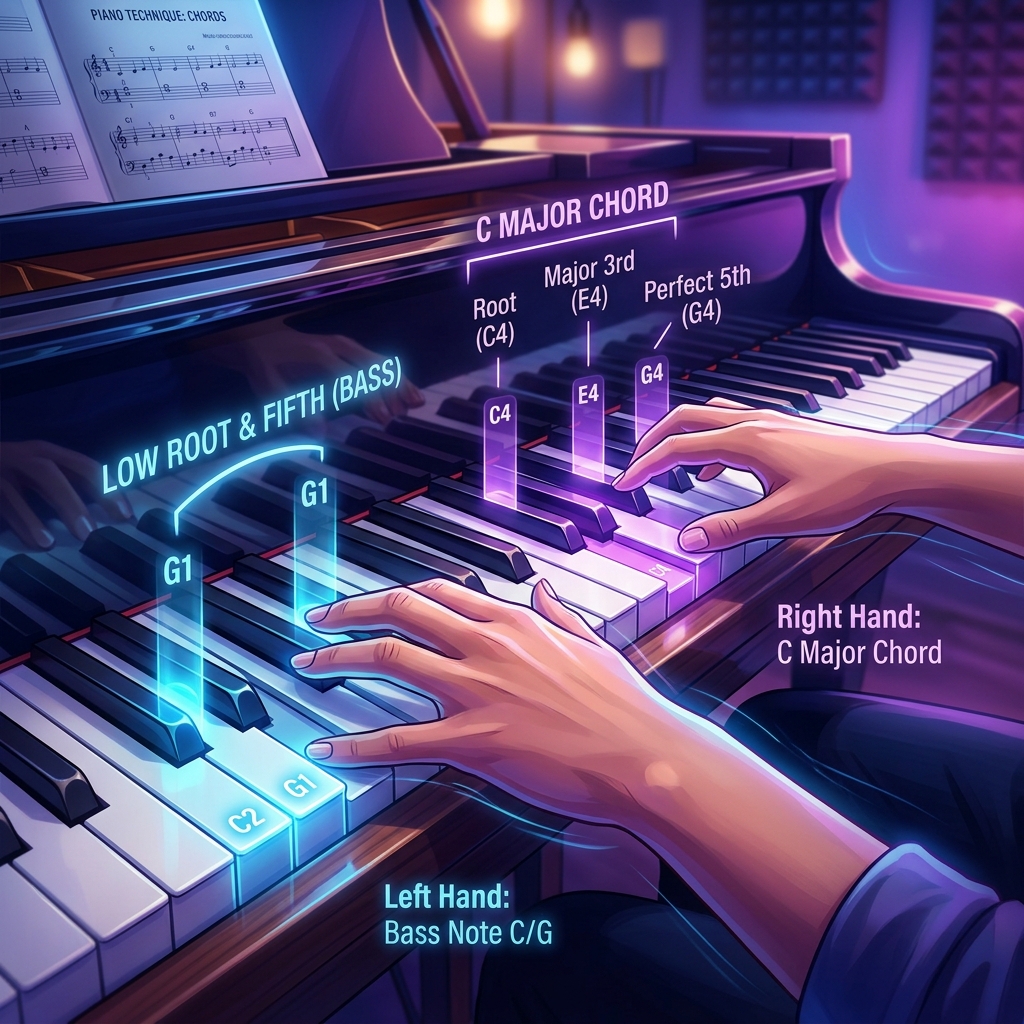
This is where the magic happens. To make your music sound rich, professional, and deep, you must use your left hand effectively.

⭐ The Gold Rule of Bass

Your Left Hand should ALWAYS play the Root Note (the BASS note) of the chord.

If you are playing a C Major chord with your right hand, play a low C (or two C's an octave apart) with your left hand. This "anchors" the sound and gives it that professional piano-ballad feel.

Two Hand Technique
Left Hand Plays Root Note (Low Bass)
Right Hand Plays the Triad or Inversion
Got it! Let's Practice Chords πŸ“–